Bullet-resistant windows from Metal Quartz provide controlled, certified protection against firearm threats, with solutions that fit within the range of secure windows and partitions. They are developed and tested according to the relevant European standards and combine aesthetics with reliable performance. The following explains the standards, testing methods, and product solutions, with concrete configurations and tailor-made options.
Standards and classifications: EN 1063 and EN 1522–1523
In bullet-resistant joinery, two complementary European standards apply. EN 1063 describes the classification and testing of bullet-resistant safety glass (BR classes). EN 1522–1523 covers the entire unit of windows, doors, and shutters (FB classes) and therefore tests not only the glazing but also the profiles, joints, and structural details. This distinction is crucial for real project situations in which all connections must guarantee the performance level.
The bullet-resistance standards define closed classes FB1 to FB7 (EN 1522–1523) and BR1 to BR7 (EN 1063). In addition, there is an open class for AK47, which in terms of penetration capacity lies between FB4 and FB5. The classification table with ammunition types, mass density, test distance, and impact velocities is summarized on page 6 of the bullet-resistance datasheet.
Bullet-resistant windows: what the tests prove (and what they do not)
The bullet-resistance test imposes a result obligation: any perforation is prohibited. This means that no projectile (or fragment) may penetrate the wall and that no passage may occur between the attack side and the protected side—even if such a passage were to close again afterwards. The official tests are conducted in accredited laboratories, including the Banc National d’Épreuve (Saint-Étienne) and the Department of Weapons Systems and Ballistics of the Royal Military Academy (Brussels).
The standards require more than just “impacts in the center.” In addition to central impact points (for example for the glazing according to EN 1063), EN 1522–1523 also provide for impact points at the joints: the connection between glass and crossbar, between sash and frame (hinge side and lock side), and—for a coherent whole—the junction with the masonry. In this way, the complete element is validated for the specified performance level. Splitting (S) and non-splitting (NS) are recorded; for the analysis, a thin aluminum film is placed on the protected side to detect and identify splinters.
Fixed bullet-resistant windows (FTMQ-0230)
The FTMQ-0230 datasheet describes our fixed burglary-resistant and/or bullet-resistant windows, developed either as 100% in-house solutions or based on Forster® profiles that we reinforce and adapt. The objective: a refined, sober design offering the level of security required by the client, validated through European tests. Various glazing types and beading variants are available so that aesthetics and budget can be balanced.
Performance and combinations
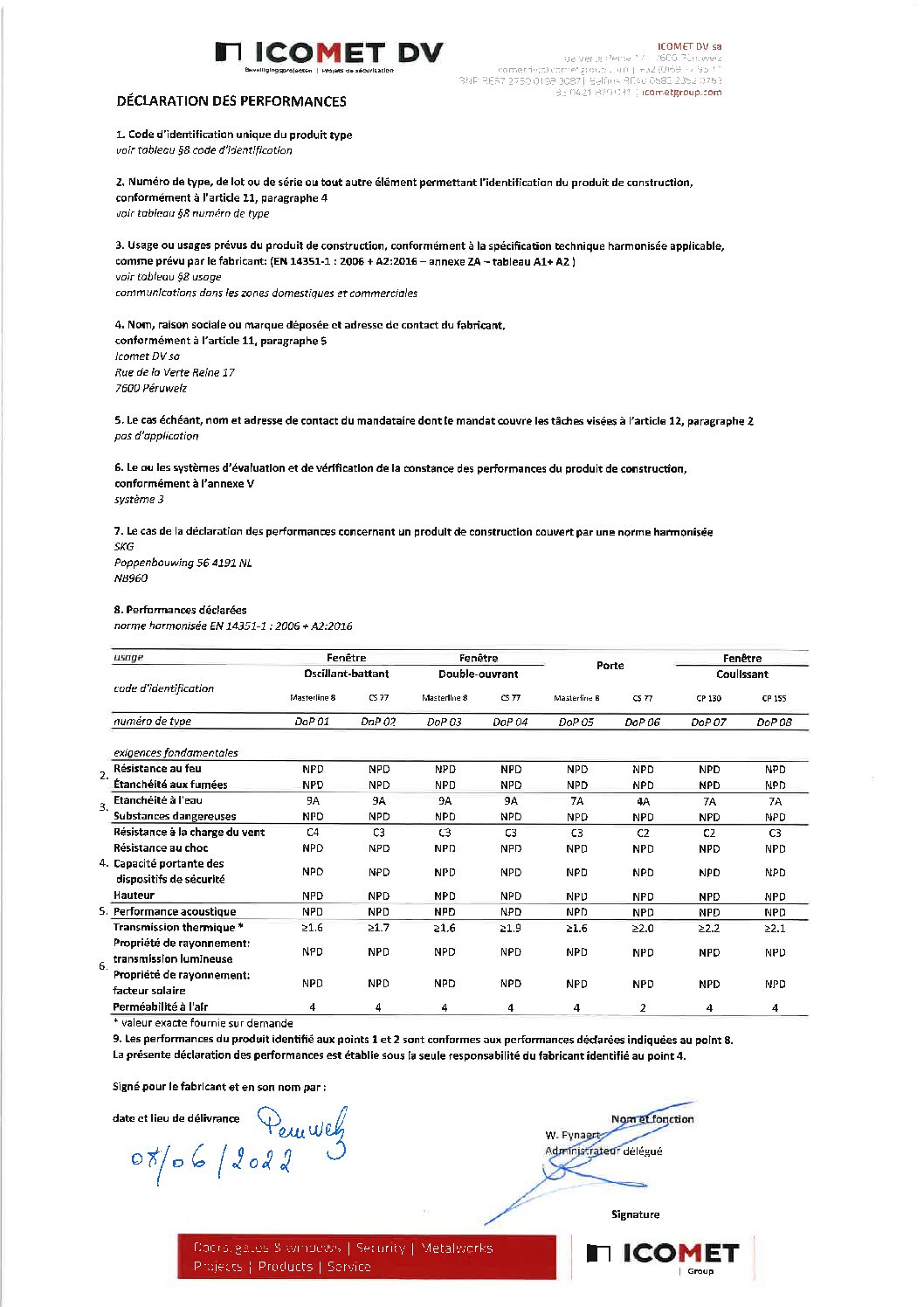
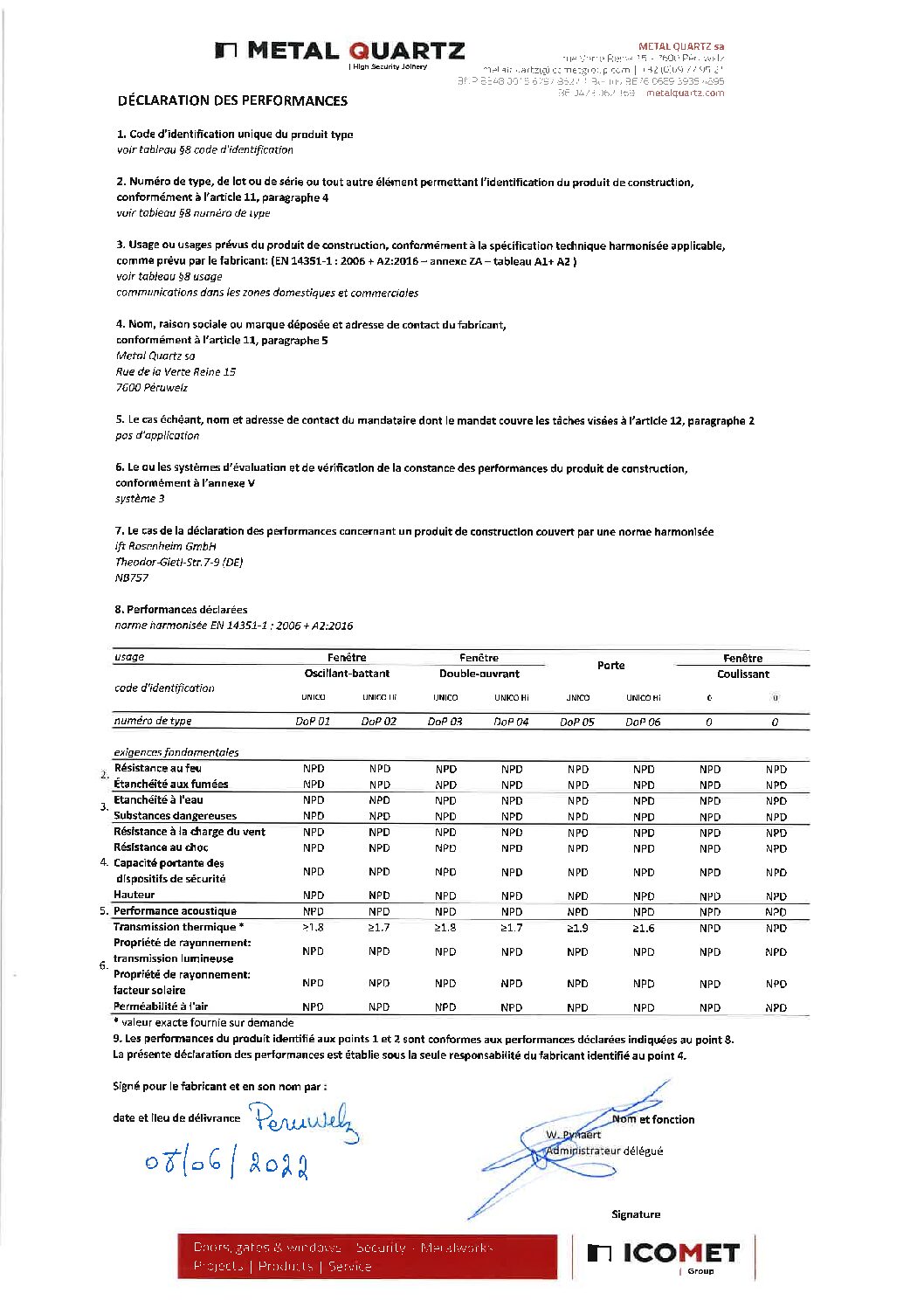
The configuration matrix (FTMQ-0230) lists bullet resistance FB4 to FB7 (including AK47) and burglary resistance RC3 to RC5 and MBE3, in different combinations. This allows the bullet-resistant window to be validated against both firearm threats and manual break-in attempts, with test campaigns conducted by accredited institutions (CNPP for RC3–RC5 and WTCB for MBE3; Banc National d’Épreuve and RMA Brussels for bullet resistance). Optional cumulative properties include thermal insulation, fire resistance, explosion resistance, air tightness, water tightness, and wind resistance.
Configurations and execution
Fixed windows can be constructed with or without a crossbar and, if desired, integrated with a door, support wall, transom, or provisions for shutters. The dimensions are custom-made; minimum and maximum values are adjusted according to the requested resistance class. For the infill, there are two families:
- Solid panels (flat sheet metal or sandwich panel).
- Glazed version with “no splitting” designation in the test results (if applicable). Finishing is available in RAL color of choice for interior and exterior use.
Prison windows (FTMQ-0201 AE20-P1)
Within bullet-resistant windows, there are also prison windows. The FTMQ-0201 datasheet describes a fixed prison window AE20-P1, available glazed or with bars. The glazed version is often used in exterior walls thanks to thermal insulation, while the barred version is used for internal compartmentalization or as a secondary layer to traditional joinery. Validation is carried out according to the Belgian Justice Standard “Prisons” (Conform P1 = 35 kN + AE20), with tests conducted by the Federal Public Service of Justice.
Dimensions, installation, and options
The standard frame dimensions of AE20-P1 are min. 500 × 500 mm; maximum (vertical) 500 × 1500 mm and (horizontal) 1500 × 500 mm. Other dimensions are available upon request. The basic equipment includes steel profiles with thermal break, RAL finishing (sandblasting / metallization / powder coating), and a 200 mm steel recess (optionally wider). Installation can be in tunnel (in the wall opening). Optionally, a bullet-resistant steel armor FB4 or FB6 can be integrated.
Bullet-resistant windows: quality of test reports and documentation
In bullet-resistant joinery, different types of documents circulate. A ballistic steel certificate demonstrates the properties of the material but not the bullet-resistant performance of the entire window. An orientation test report may be limited to a single detail (for example a joint) and is not official for the entire construction. A homologation test report validates the tested element as a whole, including the relevant joints, in accordance with the official test protocol. This distinction is essential for project comparisons.
Design and integration principles of bullet-resistant windows
- Integral validation: In projects, choose RC classes that cover the entire element (profiles, glass, joints), not just the glass (BR). This ensures performance is maintained at transition details.
- Attention to detail: The standard provides for targeted impacts on joints. In our practice, we also test the connection with the masonry to obtain a coherent, guaranteed bullet-resistant complete solution.
- Use scenarios: FTMQ-0230 covers a wide range of risk profiles (from FB4 to FB7/AK47) and can be combined with burglary resistance and environmental performances—relevant for banks, government buildings, critical infrastructure, and high-security sites. FTMQ-0201 is aimed at detention and justice environments with AE20-P1 and options for bullet-resistant armor.
Maintenance and lifecycle
Bullet-resistant windows are passive security products that maintain their functionality as long as structural integrity is preserved. For projects, this includes precise installation, regular visual inspection (joints, beads, connections), and documentation follow-up (keeping the relevant official test reports for each element type and configuration). This is in line with the philosophy of the standards, in which result (no perforation) and traceable validation are central.
FAQ
BR classes (EN 1063) apply to bullet-resistant glass. FB classes (EN 1522–1523) apply to the complete element (window/door/shutter) and therefore also include profiles and joints. For projects with real threats, the FB classification is the relevant reference.
During tests, an aluminum film is placed on the protected side to detect splinters. No splitting indicates that no splinters penetrate into the protected area according to the test record. This is particularly important for counters and close-range applications.
That depends on the risk profile. FB4 (e.g. .44 Rem. Magnum) covers lower threats; FB6–FB7 address rifle projectiles (including 7.62×51). The AK47 class (open class) lies in terms of penetration between FB4 and FB5. See the classification table on p. 6 of the bullet-resistance datasheet.