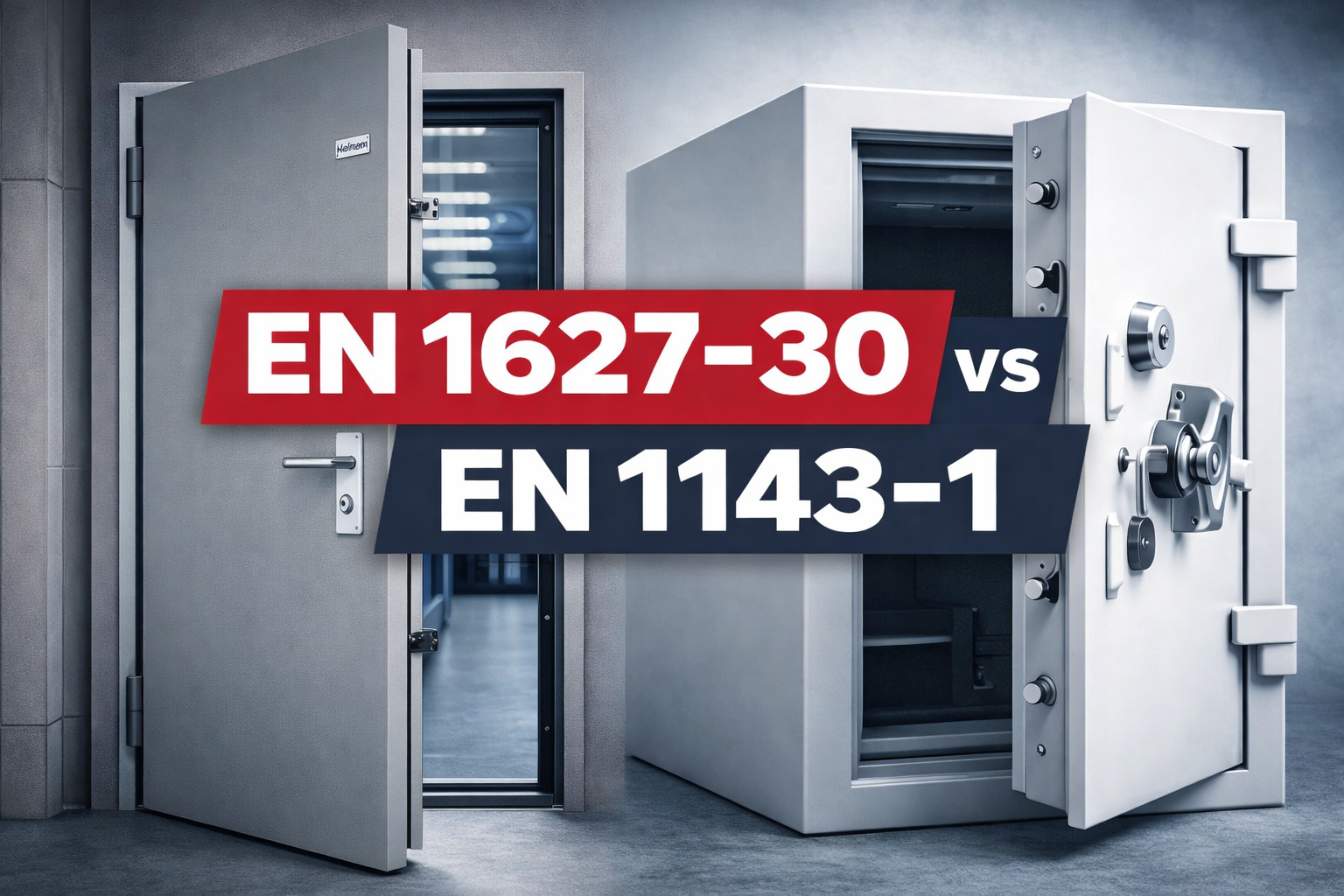
EN 1627–1630 vs EN 1143-1 – What is the difference between burglar-resistant doors and safes?
Anyone who looks into physical security quickly comes across two key European standards: EN 1627–1630 and EN 1143-1. Both standards deal with burglary resistance and are therefore often confused. Understandably so, as they share one common objective: delaying or preventing unauthorized access. But beyond that, the similarities largely end.
In this article, we clearly, practically, and professionally explain the difference between EN 1627–1630 (burglar-resistant building elements) and EN 1143-1 (safes and strongrooms). You will discover when to use which standard, how the tests are carried out, how insurers interpret them, and how to make the right security choice.
Why EN 1627–1630 and EN 1143-1 are often confused
Both EN 1627–1630 and EN 1143-1 measure resistance against burglary. However, they do so on completely different types of objects.
- EN 1627–1630 tests building components: doors, windows, façades, sliding doors, shutters, fixed walls, and similar elements.
- EN 1143-1 tests containers: safes, strongboxes, vault rooms, cash-in-transit safes, and vault doors.
In other words: EN 1627–1630 protects access to the building, while EN 1143-1 protects what is inside the building.
The two standards are therefore complementary, not competing.
What is the EN 1627–1630 standard?
The EN 1627–1630 standard defines the requirements and testing methods for burglar-resistant building elements, such as:
- security doors
- windows
- façade systems
- grilles
- shutters
- sliding doors
Resistance classes (RC1 to RC6)
Within EN 1627–1630, six resistance classes are defined:
- RC1 – basic protection against opportunistic burglary
- RC2 – protection against simple hand tools
- RC3 – resistance to screwdrivers, crowbars, and basic tools
- RC4 – protection against heavier tools and cordless drills
- RC5 – resistance to powerful electric tools
- RC6 – highest class: maximum resistance against heavy attack
The higher the class, the heavier the tools, the longer the testing time, and the more intensive the attack.
What does EN 1627–1630 actually test?
The standard consists of several test components:
- EN 1628 – Static load test
Pressure is applied to critical points to test deformation and structural weakness. - EN 1629 – Dynamic load test
A heavy swinging mass simulates brute force, comparable to kicks or shoulder impacts (performed up to resistance class 3). - EN 1630 – Manual burglary test
Trained testers attempt to physically break in using predefined tools and within strict time limits.
The objective is to gain time. The longer a door or wall resists, the greater the chance that the burglary attempt will fail.
When should you choose EN 1627–1630?
This standard is ideal when you want to:
- secure building entrances
- delay intruders
- structurally protect high-risk areas (banks, jewellers, pharmacies, data centers)
👉 View our burglar-resistant doors, grilles, fixed walls, and sliding doors according to EN 1627–1630
📕 Download our technical PDF guide: EN 1627–1630
Get a clear overview of classes, tests, and applications in 12 pages.

What is the EN 1143-1 standard?
While EN 1627–1630 focuses on the building envelope, EN 1143-1 is entirely dedicated to safes, strongboxes, vault rooms, and their doors.
This standard defines:
- testing methods
- resistance classes
- calculation of the RU value (Resistance Unit)
- insurable values per class
The EN 1143-1 classes (0 to XIII)
EN 1143-1 defines no fewer than 14 resistance classes:
0 – I – II – III – IV – V – VI – VII – VIII – IX – X – XI – XII – XIII
Each higher class corresponds to increased resistance to full access (= higher RU value) and implies:
- longer resistance times during testing
- more complex attack scenarios
- higher insurable values
What is the RU value?
Unlike EN 1627–1630, EN 1143-1 uses a mathematical formula to calculate total resistance. This RU value (Resistance Unit) takes into account:
- the effective working time of the attacker
- the type and power of the tools used (each tool is assigned a predefined coefficient reflecting its destructive capability)
The higher the RU value, the higher the resistance class.

Why is EN 1143-1 so important for insurers?
Insurers directly link maximum insurable amounts to these resistance classes. These amounts vary from country to country. For example:
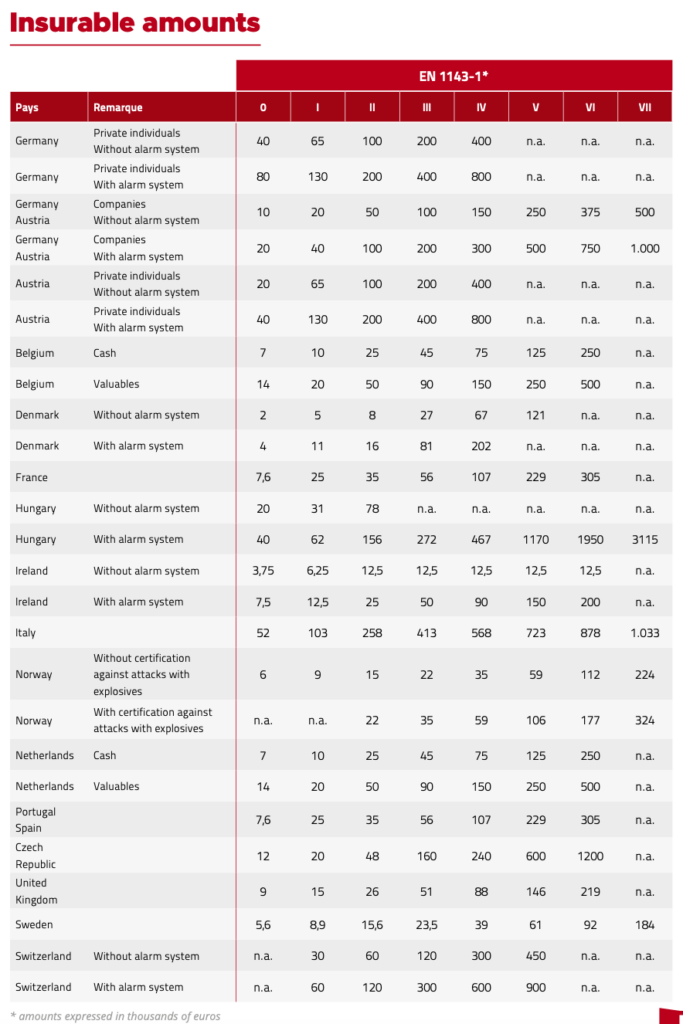
This makes EN 1143-1 the only true reference standard for secure value storage.
When should you choose EN 1143-1?
- cash storage
- jewellery
- documents
- weapons
- precious metals
- pharmaceutical products
- …
👉 View our solutions certified according to EN 1143-1:
Heavy-duty Wertheim vault rooms – maximum resistance for high-risk environments, banks, and high-value storage:
https://metalquartz.com/en/building-security-partnership/armoured-joinery-suppliers/heavy-duty-wertheim-vault-rooms-integrated-by-metal-quartz/
Modular lightweight vault rooms and vault walls by Flexofin (Bunkerkit) – ideal for rapid installation, scalability, and integration into existing buildings:
https://bunkerkit.com/en/specific-uses/modular-vault-room/
📕 Download our technical PDF guide: EN 1143-1
Everything you need to know about vault rooms, resistance classes, and insurability.

EN 1627–1630 vs EN 1143–1 – the fundamental differences
Although both standards measure burglary resistance, their starting points and objectives are fundamentally different.
1. Application
- EN 1627–1630: building envelope – doors, windows, façades
- EN 1143–1: internal security – safes and vault rooms
2. Philosophy
- EN 1627–1630: delaying access
→ aimed at delaying unauthorized access to buildings and premises, in order to deter burglary, enable detection, and facilitate intervention.
- EN 1143–1: last line of defense – maximum delay
→ represents the final and strongest level of protection before access to valuable assets.
This standard is designed as an ultimate delay barrier, with the objective of providing the maximum resistance timeagainst targeted and professional attacks.
In practice, we therefore speak of:
- a first line of defense (EN 1627–1630)
- a last line of defense (EN 1143–1)
Both systems are based on the principle of delay, but at fundamentally different resistance levels.
3. Test methodology
- EN 1627–1630: fixed test times, predefined tool sets
- EN 1143–1: unlimited test time until opening + mathematical calculation
4. Tools
- EN 1627–1630: increasing force and tools per class
- EN 1143–1: almost all tools permitted from class 0 onwards, including thermal cutting
5. Insurance value
- EN 1627–1630: may be recommended by insurers for covering major risks
- EN 1143–1: direct link to insurable amounts (mandatory)
Practical examples
Example 1 – Jeweller
- EN 1627–1630 RC4 armored door at street level
- EN 1143–1 class V vault room at the rear
→ Double security layer
Example 2 – Pharmacy
- EN 1627–1630 RC3 entrance door
- EN 1143–1 class III medicine safe
→ Legally compliant storage
Which standard do you need?
This depends entirely on:
- the risk
- the value
- the location
- insurance requirements
- the distance to the nearest police station (impact on intervention time)
In practice, we almost always see a combination of both standards.
EN 1627–1630 prevents rapid access, EN 1143–1 protects against professional attacks.
Why choose Metal Quartz?
At Metal Quartz, we design and supply fully compliant and certified solutions according to:
EN 1627–1630
- burglar-resistant doors and window frames
- fixed walls and armored partitions
- automatic sliding doors
- sectional doors
- burglar-resistant ventilation grilles
- external guard units
- security counters and transfer hatches
EN 1143–1
- safes of all types
- vault doors
- heavy vault rooms
- light and modular vault rooms
We combine engineering, manufacturing, installation, and certification into one integrated process.
Contact us for a no-obligation analysis of your security project.
Download our free PDF guides
Would you like to explore these standards in more depth?
📕 Download our technical PDF guide: EN 1627–1630
A clear overview of classes, tests, and applications (12 pages).
📕 Download our technical PDF guide: EN 1143–1
Everything you need to know about vault rooms, resistance classes, and insurability (9 pages).
📕 Download the comparison guide: EN 1627–1630 vs EN 1143–1
A straightforward comparison to help you make the right choice immediately.
The choice between EN 1627–1630 and EN 1143–1 is not an either-or decision, but a strategic combination.
- EN 1627–1630 secures your access
- EN 1143–1 secures your assets
Together they form a comprehensive security system that both prevents intrusion and minimizes loss.
Frequently Asked Questions
EN 1627–1630 tests the burglary resistance of building elements such as doors, windows, and façades, while EN 1143–1 measures the resistance of safes, vault rooms, and strongrooms.
In short: EN 1627–1630 secures access to the building, whereas EN 1143–1 secures what is inside the building.
Both standards relate to different product types, and both the test procedures (tools used and calculation methods) and their classifications differ significantly.
It is therefore impossible to compare products tested according to two completely different standards.
Insurers base their insurable values exclusively on EN 1143–1.
The EN 1627–1630 standard has no direct link to insured amounts, but is often required for building security as a complementary measure.
EN 1627–1630 may be sufficient when the objective is to delay access, for example in: offices, residential buildings, schools, healthcare facilities, retail premises, luxury boutiques, sensitive infrastructure, and the protection of documents.
Valuable items and cash that must be insured against theft, however, must be stored in equipment that complies with the EN 1143–1 standard.
Yes, and this is even the recommended approach.
A professional security concept combines: EN 1627–1630 for perimeter and access protection, and EN 1143–1 for the internal protection of valuable areas (safes and vault rooms). This ensures a multi-layered level of security and maximum risk mitigation.
RC stands for Resistance Class.
The classes range from RC1 to RC6 and indicate how long and with which tools a burglary attempt can be resisted. The higher the class, the more severe the attack that can be withstood.
The designation of the class varies depending on the language. For example:
RC – Resistance Class (English)
CR – Classe de Résistance (French)
RC – Resistance Class (Dutch, official designation)
WK – Weerstandsklasse (Dutch, older and still commonly used designation)
In Dutch, RC is now the official term, but WK is still frequently used in practice, particularly in older documentation and within the construction sector.
RU stands for Resistance Unit. It is a calculated value that expresses the total burglary resistance based on: the working time of the attacker, the type of tools used, and their power. This value determines the class (0 to XIII) in which a safe or vault room is classified.
A burglar-resistant door can delay access, but it offers insufficient resistance against targeted attacks on the storage of valuable goods that must be insured.
Burglar-resistant doors are, however, widely used to prevent access to high-risk buildings, including in situations where non-insured cash is stored.
These sectors almost always require a combination of both standards: RC4 to RC6 according to EN 1627–1630 for the building envelope, and Class III to XIII according to EN 1143–1 for internal security. The exact choice depends on the risk analysis and insurance requirements.
This is determined through a professional risk analysis that takes into account the type of building, the value stored, the burglary risk, and the insurance requirements. Our specialists will be pleased to assist you in correctly determining the required resistance classes.